Search this blog

Showing posts with label primary_sources. Show all posts

Saturday, February 18, 2012

Find the time to upgrade your lessons for the 21st Century

Over the last few weeks, I have heard some great ideas for making my lessons more effective in the classroom.  I am not resistant to change and technology integration, but like most, I don’t always have time for all of the logistics.  Guess what, I just found the time!
This is my lucky month.  No excuses!  I have an extra day!  Inspired by Heidi Hayes Jacobs (at FETC) I am going to take one small step and upgrade just one lesson for the 21st Century. Why not ask your principal if you could leap over one faculty meeting and spend the time upgrading the content, skills and assessments to bring it into 21st Century ?  Surely you have one lesson that could use an overhaul!   Technology can provide ideas, content, tools to help you do just that.

Looking for some ideas?  Visit www.curriculum21.com  for a comprehensive library of lessons that reflect upgrades in content, delivery, and assessments.

Upgrade your content by linking to videos from youtube or schooltube to give students a visual introduction to lessons.  Use Google News to search for current events on specific topics.  Visit the Library of Congress site to find primary documents.  There are many new ways to upgrade your content.  Did you know that Wikipedia is now considered as reliable as Encyclopedia Britannica?

Incorporate the 4C’s – creativity, collaboration, critical thinking and communication.
Is brainstorming part of your lesson?  Use wallwisher, linoit, or edistorm – simple post it note tools.  Students can see each other’s postings, reflect and comment on them.  Media and other resources can be attached to postings.

Do you hold class discussions?  Get kids started with a prompt in a discussion tool, like Collaborize Classroom  including visuals, informational text, etc to start the discussion at home.  Collaborize Classroom, a free discussion platform has a whole library of high quality questions that can be copied to your classroom site with the push of a button.

Are you looking for problem or challenge based learning?  Use the SCAN tool at TregoED to teach students a problem solving strategy based on the acronym SCAN.  Use the free problem based scenarios to have your students participate in a session practicing true collaboration.  Lessons are easy to set up and students just log in with a screen name (no registration, passwords, etc.)

No matter what you chose to upgrade, technology can decrease your workload, increase student engagement and give them opportunities to practice 21st century skills within the content.

Take advantage of of leap day!  Take the time to take the first step.  (And while you’re at it, why not ask your principal to take the leap and let you use the time at another faculty meeting sharing your successes?)

Friday, February 3, 2012

Making Black History Month Relevant to Teens

Want to make your black history month studies more relevant to your students? Get them to think historically by getting them to “walk a mile in someone else's shoes.” 

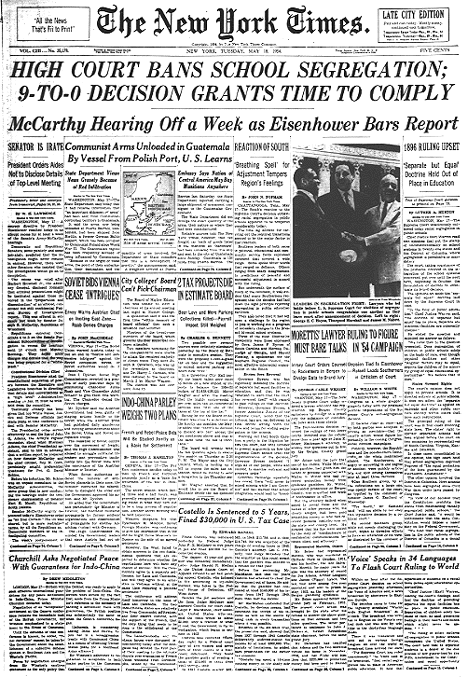
Check out these great resources to get your kids talking about the Little Rock Nine- nine black students their age who were among the first to step foot in white schools after sixty years of “separate but equal” laws.

Start the discussion

Check out this Collaborize Classroom topic from the TregoED library “Put Yourself in the Shoes of the Little Rock Nine” which uses an interview with Melba Beals – as she describes her point of view as one of the Little Rock Nine students.
Follow it up with the free lesson:  “Desegregating Schools:  A Historical Perspective” from the SCAN library at TregoED.  Students will discuss the issues of desegregation through the eyes of Linda Brown, parents, community members and local police as they work to resolve the problems that occurred when the schools had to desegregate with “all deliberate speed.”

More Resources: 

Primary documents:
Children’s nonfiction titles:
Online curriculum:
Background information:

Relevance and rigor:  the key to keeping kids engaged and thinking!

Monday, December 5, 2011

Want kids to think historically? Go to the Source!

   When trying to get students to think critically about historical events, what better place to start than primary sources?  As the new Common Core Standards call for increased reading of challenging informational texts in a range of subject areas, teachers will be looking for easy access to primary documents and strategies to help our student’s comprehension of this type of reading.   Simple strategies that ask questions of our students help to guide and document their thinking.
The Library of Congress (loc.gov) provides sets of primary sources.   They also provide a “Teacher’s Guide and student worksheet (www.loc.gov/teachers) with a strategy for helping our students think critically while using the documents.  The strategy is based on questions that will have students observe, reflect, and question.  
Thanks to Jennifer Hanson, Marcy Prager, and Ann Marie Gleeson from PrimarySource.org for sharing a number of wonderful links to primary documents, resource guides, articles and teaching strategies at their workshop at the recent NCSS Annual Conference.  PrimarySource also provides a series of questions and a student worksheet to guide critical thinking on informational texts. Their Primary Source Analysis worksheet provides questions to determine the what, when, who, why, and questions students may have.   They also provide classroom-ready activities for students on their site as well as great links to sites that provide primary sources.
TregoED provides a critical thinking strategy and online discussion tool that takes student thinking one step further.  The SCAN online discussion tool at TregoED.org allows teachers to link primary sources to lessons help students learn and appreciate point of view.  Students determine the issues that are important to each point of view represented, collaborate and analyze the actions that were taken and discuss possible alternatives to gain a deeper understanding of the event.  Students begin to think historically as they work through the questions from the SCAN critical thinking strategy (See the issues, Clarify the Issues, Ask What’s Important, and Now, what’s next?) on such events as the Boston Tea Party, Manifest Destiny, or the Patriot Act. 
Primary documents are a great way to increase student reading and comprehension of informational texts.  For links to more resources for primary documents, check out the resource tab in this livebinder.