Search this blog

Showing posts with label critical. Show all posts

Monday, November 19, 2012

CCSS lesson: Arguing the School Calendar


It’s easy to get kids writing an argument when they are passionate about a subject and who is not passionate about the school calendar?  Just open up the discussion on year round schools or what religious holidays will be observed can spark a debate.  Adjusting the school calendar for emergency days adds the complexity of previous plans and often emotions run high.  With the recent Hurricane on the East Coast, many schools have been closed to two full weeks.  Why not have your students do some critical thinking and problem solving around the topic of Emergency School Closings?
Perspectives
To get the argument started have students take on the role of parent, Board of Education, teacher and student and read the articles below:
Informational text Resources:
See the Issues
As an individual, have students list the issues they come across for their point of view as they are reading.  List all class issues.
Clarify the issues:
Ask students to clarify the issues that have been posted.  Students should refer back to the articles to see if there is an explanation as to why the issue is important. 
Ask what’s Important
As a class determine what issues are most important to consider when coming up with a solution.
No, what should be done? 
Work as a class to determine what should be done to adjust the school calendar keeping the most important issues in mind. 
Get them writing:  Ask students to describe and defend the new plan making sure they acknowledge other options and points of view.
Online SCAN Tool:
Increase student engagement and participation in this discussion using the SCAN tool at TregoED.  The private online discussion tool walks students through these steps, allows them to comment and collaborate on the solution.  “School Calendar and Emergency Days” is a free SCAN scenario this month featuring these points of view and including links to the articles. 
I guess if you live in a sunny spot with no weather issues you may never have to face the problem of emergency school closings…perhaps you may want to have your students look at the issues involved in the “Year Round School” Scenario. 
This same problem solving strategy can be used at the administrative level.  Check out “5 Steps to Help Your School with Post-Disaster Management” to see how this strategy can work for you.

Saturday, February 18, 2012

Find the time to upgrade your lessons for the 21st Century

Over the last few weeks, I have heard some great ideas for making my lessons more effective in the classroom.  I am not resistant to change and technology integration, but like most, I don’t always have time for all of the logistics.  Guess what, I just found the time!
This is my lucky month.  No excuses!  I have an extra day!  Inspired by Heidi Hayes Jacobs (at FETC) I am going to take one small step and upgrade just one lesson for the 21st Century. Why not ask your principal if you could leap over one faculty meeting and spend the time upgrading the content, skills and assessments to bring it into 21st Century ?  Surely you have one lesson that could use an overhaul!   Technology can provide ideas, content, tools to help you do just that.

Looking for some ideas?  Visit www.curriculum21.com  for a comprehensive library of lessons that reflect upgrades in content, delivery, and assessments.

Upgrade your content by linking to videos from youtube or schooltube to give students a visual introduction to lessons.  Use Google News to search for current events on specific topics.  Visit the Library of Congress site to find primary documents.  There are many new ways to upgrade your content.  Did you know that Wikipedia is now considered as reliable as Encyclopedia Britannica?

Incorporate the 4C’s – creativity, collaboration, critical thinking and communication.
Is brainstorming part of your lesson?  Use wallwisher, linoit, or edistorm – simple post it note tools.  Students can see each other’s postings, reflect and comment on them.  Media and other resources can be attached to postings.

Do you hold class discussions?  Get kids started with a prompt in a discussion tool, like Collaborize Classroom  including visuals, informational text, etc to start the discussion at home.  Collaborize Classroom, a free discussion platform has a whole library of high quality questions that can be copied to your classroom site with the push of a button.

Are you looking for problem or challenge based learning?  Use the SCAN tool at TregoED to teach students a problem solving strategy based on the acronym SCAN.  Use the free problem based scenarios to have your students participate in a session practicing true collaboration.  Lessons are easy to set up and students just log in with a screen name (no registration, passwords, etc.)

No matter what you chose to upgrade, technology can decrease your workload, increase student engagement and give them opportunities to practice 21st century skills within the content.

Take advantage of of leap day!  Take the time to take the first step.  (And while you’re at it, why not ask your principal to take the leap and let you use the time at another faculty meeting sharing your successes?)

Friday, February 3, 2012

Making Black History Month Relevant to Teens

Want to make your black history month studies more relevant to your students? Get them to think historically by getting them to “walk a mile in someone else's shoes.” 

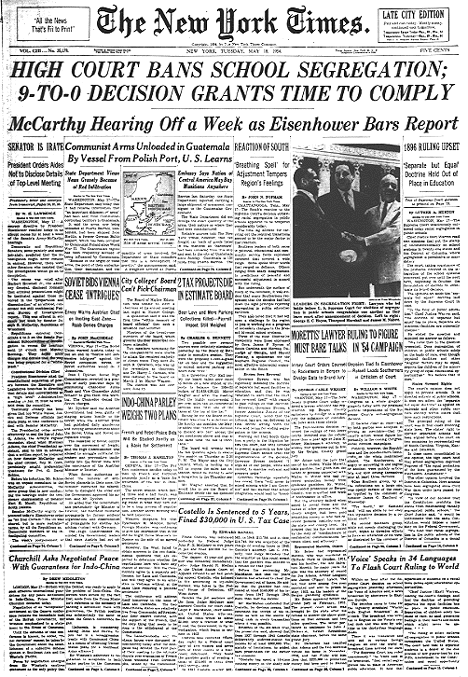
Check out these great resources to get your kids talking about the Little Rock Nine- nine black students their age who were among the first to step foot in white schools after sixty years of “separate but equal” laws.

Start the discussion

Check out this Collaborize Classroom topic from the TregoED library “Put Yourself in the Shoes of the Little Rock Nine” which uses an interview with Melba Beals – as she describes her point of view as one of the Little Rock Nine students.
Follow it up with the free lesson:  “Desegregating Schools:  A Historical Perspective” from the SCAN library at TregoED.  Students will discuss the issues of desegregation through the eyes of Linda Brown, parents, community members and local police as they work to resolve the problems that occurred when the schools had to desegregate with “all deliberate speed.”

More Resources: 

Primary documents:
Children’s nonfiction titles:
Online curriculum:
Background information:

Relevance and rigor:  the key to keeping kids engaged and thinking!

Friday, January 20, 2012

Online Discussions Defrost Brain Freeze


Do simple writing prompts freeze the minds of your students?  How do you use technology to help students flesh out their essays?  How can you help them get out of the "I don't know what to write, so I will write the same thought in 16 different ways?

Writing is often assessed for focus, organization, development of ideas, voice and conventions.   We found that most of our students were familiar with the writing process, but did not know how to develop their ideas into meaningful and detailed prose, a skill required in state testing.  How do we help our students develop ideas and voice when faced with a simple prompt?

 Improving Student Writing
Studies show that students’ writing improves when they have an audience and purpose, an interest or passion, and time to think about it.  Unfortunately, when it comes to high stakes testing, students don’t feel like they are given the time or information to develop the content.  We give them a process or strategy to deal with writing and mechanics, why not also give them a process to help them build a framework for developing their ideas?  Giving students practice and a set of questions can help improve their writing by helping them learn how to elaborate and incubate ideas from a writing prompt.  Using online discussion tools can help provide students with an engaging and motivational tool to practice this thinking process.

SCAN Online
Similar to Glogster, Voicethread, MovieMaker, PhotoStory and any number of other great Web 2.0 tools, the SCAN tool provides a communication interface for students to share, review and respond to each other’s work.   However, what elevates SCAN above all of the other tools is that students do not use SCAN after their research or thinking is complete.  SCAN actually provides a process to help students see other perspectives and develop a depth of understanding of the issues.  Exploring other perspectives and considering them in their writing can help students develop writing that is thoughtful and insightful.
 
Giving Kids Perspective
Using the SCAN online tool, students take on the part of a perspective provided in a scenario that they will represent by identifying and clarifying issues, assessing what is important and communicating what they think should be done.  This built-in process helps students collaborate to resolve the issues and present real solutions.  These same four steps (See the issues, Clarify the Issues, Assess what’s important, and Now, Name your next steps) can be used by students to help them develop a thoughtful essay when given a simple writing prompt. Simply going through these four steps in the pre-write, can help students avoid the “I don’t know what to write so I write the same thought over and over in different ways” problem.  We have found that using the SCAN tool can help our students assimilate this simple strategy to organize their thinking when faced with a simple writing prompt.

For resources to help students use the SCAN process in writing go to http://www.tregoed.org/teachers/students.html.
To see a short video on how the SCAN tool works go to http://www.tregoed.org/teachers/new-to-scan.html

Tuesday, January 3, 2012

Dr. King's Dream


Remembering Dr. King’s legacy is a relevant activity in any classroom whether covering bullying, the economy, world peace, social justice or looking for relevant nonfictional reading and writing across several disciplines. Plan ahead using some of these great resources to get your students thinking.

For Students:

Students get a small taste of what segregation feels just entering the site.  They can listen to Dr. King’s speeches or read some of his other writings at Remember Segregation.  Simply powerful.

Watch a video on Dr. King, fill out a KWL graphic organizer, take a quiz, or study relevant vocabulary at BrainPop

Read the Story of Martin Luther King and find related facts, figures and folklore. (some ads)

Play the “It’s Not Fair Game” to learn about and experience prejudice first hand!  Fun- teaches students MLK related vocabulary while skewing the score to discover how it feels when "it's not fair!"

For Teachers:
Teachersfirst (a great FREE teacher resource page) has links to many different MLK resources including video links, lesson ideas, materials, and interactive sites.

See what other teachers are doing for MLK day at Scholastic’s site.   

Watch great historical videos of the Civil Rights Movement and Rev. King

Try out this free SCAN lesson “Dr. King’s Dream.”  Register from the dashboard, set up the lesson and send kids to your private URL to discuss whether Dr. King’s dream has been reached in their school, state, country or globally. They will look at issues from each perspective and name some action steps that you might take to solve them.  New to SCAN?  Start here.

Students can make a difference:  Read the 6 Steps to Nonviolent Social Change and remind students of the small everyday things they can do such as not judging others by their appearance or actions, sticking up for others, or learning more about different religions and cultures. Have them make a list of actions that they can do to reach MLK's dream.

How will you honor his legacy and work towards his dream?

Tuesday, December 13, 2011

Ripped from the Headlines


How do we keep our lessons relevant and rigorous?  Use information ripped from the headlines and a critical thinking strategy. 
Some of the best lessons are ones that apply the skills we are teaching to relevant scenarios.  Just looking at the headlines for today, I can see at least 10 engaging complex situations that students could use to practice their problem solving skills.  Current events can and should be used to increase our student’s exposure to informational text across the disciplines, as required in the common core.
 Today’s headlines include obvious connections with science, social studies and language arts curricula.  Quick discussions in science can come from posing questions that will apply scientific principals and environmental issues to the news – Should we have a bear hunt to control populations? Should parents opt out of children’s vaccinations?   Should raw milk be legal?  Who is responsible for paying for flood damage?  Should fracking be allowed? 
In social studies, current events can be used to look at current laws, cultural diversity, and society -What are the criminal charges resulting from a suicide in connection with cyberbullying?  Should Egypt ban the drinking of alcohol, bikinis and mixed bathing for tourists? Should local police in Arizona help enforce immigration laws? Should we change marriage licensing laws to take advantage of wedding tourism?  What can be done to decrease the amount of homeless children? Should people be able to bet from their computers or cell phones? Each of these news items give perspectives on complex issues that ask our students to think beyond just facts. 
 Language arts teachers are given the daunting task of keeping our students engaged in reading and writing everyday.  All of these current events can be used in the language arts classroom to increase reading and comprehension of informational texts.  Using the SCAN critical thinking strategy rather than the usual: who, what, where, when, how, and why, students will not only gain a deeper understanding of the problem but they can take their thinking one step further and propose their own solutions.
Using the SCAN strategy is easy (SCAN-See the issues, Clarify the issues, Ask yourself what’s important, and Now, what should be done?).  You can provide a simple, relevant lesson by having students read the article,highlight or research perspectives (from the article or other sources), brainstorm the issues, clarify the issues, determine what is most important and propose what should be done.   
Check out this great article about a school policy on cell phones.  The article includes points of view from board members, the board attorney, students and parents.  There are also some great opinions expressed in the comment section! 
To use SCAN with “no tech,” have students read a hard copy of the article, put them in groups to represent a point of view and discuss the issues. They can record their issues on paper or on poster sheets.   Jigsaw students so that each point of view is represented in a group and have them clarify their issues, determine which issues are most important by voting with dots from different color markers on the issue lists. Have students work together to determine what action should be taken.  A simple article is the basis of a simple lesson that includes active reading, critical thinking, collaboration, and relevant content! 
Go high tech and have students discuss the issues online through the SCAN online tool.  The lesson is free through this month.  Simply go to www.tregoed.org, (register-it’s free), and set up the lesson through your dashboard, print out a student worksheet, give students the url and they will be guided through the SCAN process online!
Either way, combining current events and critical thinking is a simple way to bring rigor and relevance to your classroom!

Thursday, October 20, 2011

Online Discussions: Trick or Treat?

I love Halloween!  There is something about wearing a costume that is fun and liberating!  Who does not love to pretend to be someone or something else for a night?  I guess that is the appeal for many when they choose to represent themselves as someone else online. 

We often hear of the negative aspects of children using online discussion formats.  Hiding behind screen names is often the impetus behind cyber-bullying, etc.  However, using screen names and avatars in online discussions may also be the impetus for our students to get engaged in class discussions.  Guiding conversations, monitoring input and documenting transcripts of discussions can provide the supervision you need to eliminate the risks of using this format with your students.
Classroom discussions are usually dominated by a few “alpha” students who are eager to participate.  We can all envision those students, hands stretched high, waving fingers, literally or figuratively saying “ooo, ooo, pick me, pick me.”  How do you get that student who is desperately trying to NOT make eye contact with you or anyone else in the classroom involved in the conversation?  Social media may be the answer. 
I have seen web 2.0 tools such as collaborizeclassroom.com, wallwisher.com and the SCAN tool at TregoED  transform students from reluctant participants to vigorous commentators.  Online tools offer students a platform that they are familiar and comfortable with and give students a voice that is heard with equal merit to the rest.
Properly supervised, social media can help us get all kids in on the conversation and allow them to practice the skills they need to carry over to those times when their conversations are not monitored.  My experience has been that the benefits of online classroom discussion outweigh the risks.  What has your experience been?

Wednesday, July 20, 2011

ISTE Keynote Highlights- what does the brain have to do with thinking/learning?

Great presentation by Dr. John J. Medina, molecular biologist, who laughingly wondered by ISTE would select someone from his field as they are not well known for exciting keynotes.  With great humor and energy, he made the following points:
1.  We know very little about how the brain works.
2.  Mythbuster alert:  what we do know is not always right - for example, we do not only use 10% of our brains, there is not a left brain, right brain dichotomy.
3.  Every brain is wired differently from every other brain and learns in ways unique to the wiring.
4. Every brain is wired differently from every other brain and learns in ways unique to the wiring. (Yes, I put that twice because it is important)
5.  What is obvious to you is obvious to you.
6.  Theory of mind (google ToM) can be active or passive and is sometimes referred to as empathy.  It is the one characteristic that can determine is a teacher will be successful.  It is the ability to look at a child and know that you have confused them or excited them, etc.  Can we teach a computer to do this?  Would we want a computer to do this?
7.  The emotional stability of the home is the biggest predictor of academic success.
8.  If he were to design a school based on what we know- students would wear uniforms (and they would be gym clothes) because it has been shown that aerobic exercise increases learning.
9.  His school would have a full aerobic program with pockets of time inbetween for learning (ironic - we do just the opposite now).
10.  Men are from Mars, women are from Venus
11.  There is a chemical called Kryptochrome which is the guardian of our sleep schedule.  Blue light (often given off by our electronics) can disrupt the chemical which may disrupt our sleep schedule.  This has the potential for problems for some of our students.
12.  What did I miss.......