Search this blog

Showing posts with label history. Show all posts

Friday, February 3, 2012

Making Black History Month Relevant to Teens

Want to make your black history month studies more relevant to your students? Get them to think historically by getting them to “walk a mile in someone else's shoes.” 

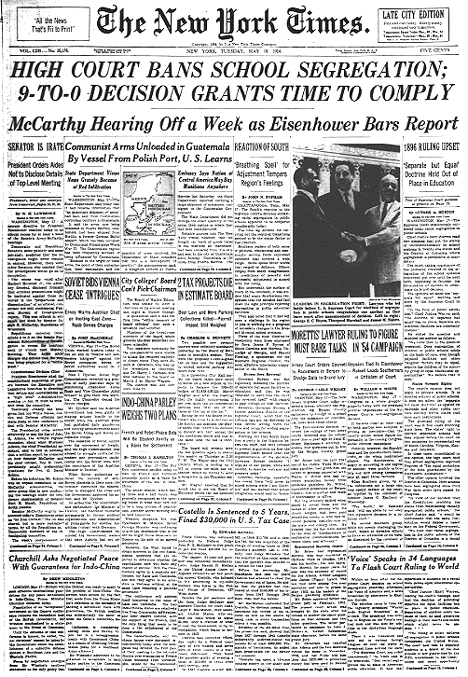
Check out these great resources to get your kids talking about the Little Rock Nine- nine black students their age who were among the first to step foot in white schools after sixty years of “separate but equal” laws.

Start the discussion

Check out this Collaborize Classroom topic from the TregoED library “Put Yourself in the Shoes of the Little Rock Nine” which uses an interview with Melba Beals – as she describes her point of view as one of the Little Rock Nine students.
Follow it up with the free lesson:  “Desegregating Schools:  A Historical Perspective” from the SCAN library at TregoED.  Students will discuss the issues of desegregation through the eyes of Linda Brown, parents, community members and local police as they work to resolve the problems that occurred when the schools had to desegregate with “all deliberate speed.”

More Resources: 

Primary documents:
Children’s nonfiction titles:
Online curriculum:
Background information:

Relevance and rigor:  the key to keeping kids engaged and thinking!

Monday, December 5, 2011

Want kids to think historically? Go to the Source!

   When trying to get students to think critically about historical events, what better place to start than primary sources?  As the new Common Core Standards call for increased reading of challenging informational texts in a range of subject areas, teachers will be looking for easy access to primary documents and strategies to help our student’s comprehension of this type of reading.   Simple strategies that ask questions of our students help to guide and document their thinking.
The Library of Congress (loc.gov) provides sets of primary sources.   They also provide a “Teacher’s Guide and student worksheet (www.loc.gov/teachers) with a strategy for helping our students think critically while using the documents.  The strategy is based on questions that will have students observe, reflect, and question.  
Thanks to Jennifer Hanson, Marcy Prager, and Ann Marie Gleeson from PrimarySource.org for sharing a number of wonderful links to primary documents, resource guides, articles and teaching strategies at their workshop at the recent NCSS Annual Conference.  PrimarySource also provides a series of questions and a student worksheet to guide critical thinking on informational texts. Their Primary Source Analysis worksheet provides questions to determine the what, when, who, why, and questions students may have.   They also provide classroom-ready activities for students on their site as well as great links to sites that provide primary sources.
TregoED provides a critical thinking strategy and online discussion tool that takes student thinking one step further.  The SCAN online discussion tool at TregoED.org allows teachers to link primary sources to lessons help students learn and appreciate point of view.  Students determine the issues that are important to each point of view represented, collaborate and analyze the actions that were taken and discuss possible alternatives to gain a deeper understanding of the event.  Students begin to think historically as they work through the questions from the SCAN critical thinking strategy (See the issues, Clarify the Issues, Ask What’s Important, and Now, what’s next?) on such events as the Boston Tea Party, Manifest Destiny, or the Patriot Act. 
Primary documents are a great way to increase student reading and comprehension of informational texts.  For links to more resources for primary documents, check out the resource tab in this livebinder.


Monday, November 28, 2011

6 New Ways to Look at Pearl Harbor

“Successful problem solvers are the ones that can look at a problem from a new angle, consider alternate points of views and deal with several sources of information all at once.”  (Habits of Mind # 4 - Think flexibly.)  Why not take a look at these resources and use the power of personal accounts and different perspectives on Pearl Harbor to help your students practice flexible thinking.
#1.  Visit this site to provide a wide range of perspectives from personal accounts to maps and photographs to establish the logistics of the attack on Pearl Harbor. http://www.reacheverychild.com/feature/pearl_harbor.html
#2 Consider why the Japanese would want to attack the US  http://www.nationalgeographic.com/xpeditions/lessons/13/g35/legacy.html consider why the Japanese would want to attach the US
#3 Have students look at these primary documents, oral histories and survivor accounts and describe the perspective of the writer. http://www.history.navy.mil/branches/teach/pearl/opening.htm
#4 – Compare text book accounts between a Japanese text book and their own. http://www.nps.gov/nr/twhp/wwwlps/lessons/18arizona/18putting.htm -Activity 2
#5 – Look at different perspectives from eyewitness accounts. http://www.discoveryeducation.com/teachers/free-lesson-plans/pearl-harbor.cfm 
#6 – Try the free lesson “A New Approach to Remembering Pearl Harbor” using the SCAN tool at www.tregoED.org .  Register (it’s free) and set up the lesson, send students to the unique url to help them understand the merits of looking at history from all perspectives as they discuss the new visitor’s center at Pearl Harbor featuring the Japanese perspective.  Based on this article - http://www.msnbc.msn.com/id/42862187/ns/travel-destination_travel/t/pearl-harbor-museum-now-shows-japanese-perspective/